

September 2026 Jobs Report: What It Means for Employers

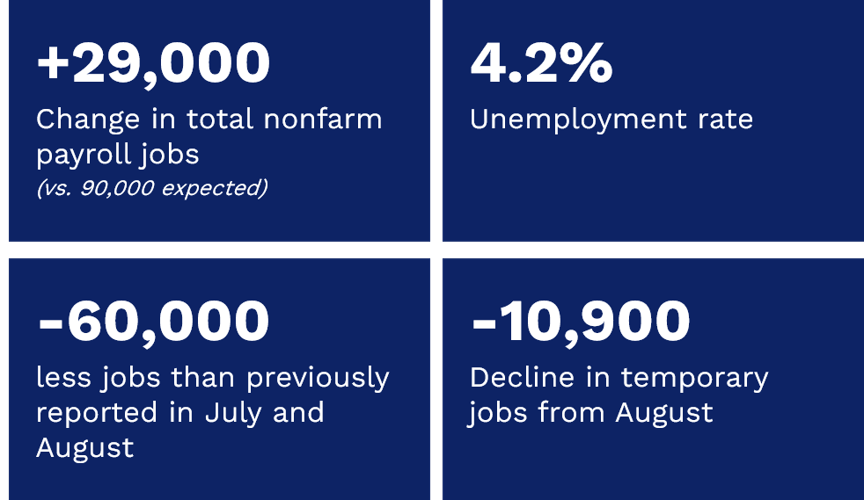
When we reviewed the August jobs report last month, the open question was whether 162,000 new jobs marked the start of a durable improvement or a strong month inside a still-selective market. September answered it. Employers added just 29,000 jobs, well below the roughly 90,000 economists polled by Reuters had expected, and the Bureau of Labor Statistics revised the summer months lower. The unemployment rate rose to 4.2 percent.
For financial services employers, the headline matters less than three details underneath it. The first is a sector decline that looks very different when measured over 16 months instead of one. The second is a pause in the temporary help growth we have tracked since spring. The third is wage data that points to a retention problem building quietly inside organizations.
September 2026 Labor Market at a Glance
The Summer Rebound Was Smaller Than First Reported
August’s gain was revised from 162,000 to 133,000, and July moved from a reported gain to a loss.
| Previously reported | Latest estimate | |
| July | +21,000 | -10,000 |
| August | +162,000 | +133,000 |
Those revisions bring the three-month average to 51,000 jobs. JPMorgan’s chief U.S. economist described that pace as close to breakeven.
The data also warrants caution in the other direction. Reuters noted that payrolls tend to underperform when Labor Day falls late in the month, as it did this year, and that jobless claims remain near 57-year lows. The fairest reading is that hiring has settled near the minimum needed to hold unemployment steady, which leaves employers and workers with little cushion if conditions weaken. Part of the rise in unemployment also came from more people entering the labor force, with participation edging up to 61.8 percent from 61.6 percent in August.
The Low Hire, Low Fire Pattern Is Holding
The “low hire, low fire” environment we described in our August jobs report analysis remains firmly in place. RSM’s chief economist, Joe Brusuelas, called it his baseline forecast after the September release and said employers should expect the soft pace of hiring to continue. Layoffs remain unusually low. Challenger, Gray & Christmas data shows job cuts through September down 40 percent from the same period last year. Meanwhile, Indeed Hiring Lab reports that job openings have trended up since late 2025 while actual hiring has stayed flat.
The pattern persists because employers continue to signal demand they are not acting on. For hiring leaders, that means competition centers on a small number of approved roles, and candidates who are employed and secure have little reason to move without a compelling offer.
Temporary Help Paused After a Run of Gains
Temporary help growth has been a recurring signal in our recent reports, adding 3,400 jobs in July and 6,800 in August. September broke the streak, with temporary help services declining by 10,900. The American Staffing Association’s weekly index tells a steadier story, rising 0.5 percent from August and remaining 3.3 percent above last year. That makes one month of BLS data a reason to watch the trend rather than evidence that it has reversed.
Our read is that employers are applying the same scrutiny to contract engagements that they have applied to permanent headcount all year. Contract and contract-to-hire arrangements earn approval most easily when they are tied to a defined deliverable, a clear timeline, and an agreed point for making a conversion decision.
The Retention Risk Inside the Wage Data
In August, we noted that wage growth of 3.1 percent was running below inflation. In September, average hourly earnings rose only 0.1 percent for the month and 3.0 percent over the year, while inflation has picked up.
Other data suggests the squeeze is affecting how employees feel about their jobs. Glassdoor’s employee confidence measure fell to a record low in September, and its chief economist observed that frustrated workers cannot easily leave bad jobs in the current market. ADP’s pay data shows job changers earning gross pay gains of 7.3 percent versus 4.4 percent for employees who stayed.
Low turnover may therefore be masking dissatisfaction. The employees who stay because their options are limited are often the most likely to leave once hiring picks up, and in financial services they tend to be the experienced compliance, risk, and technology professionals who are hardest to replace. The Federal Reserve raised rates in September and is widely expected to hike again in December, which could keep hiring slow for some time. That timing postpones the retention risk without removing it.
What Financial Services Employers Should Do Now
- Benchmark talent plans against your specific subsector and function rather than industry-wide figures.
- Review compensation for your hardest-to-replace roles before year-end budgets are finalized.
- Identify likely flight risks in critical seats and build backfill pipelines before you need them.
- Scope contract engagements around clear outcomes, a timeline, and a planned conversion decision.
What to Watch in the October Report
The October report is scheduled for November 6. Three signals deserve attention: whether the temporary help decline continues, whether financial activities losses spread beyond insurance, and how the Fed’s late-October and December decisions affect hiring approvals heading into 2027.
Conclusion
September removed much of the optimism that August briefly added, while confirming a labor market that is holding steady with very little margin. For financial services employers, the larger story sits beneath the headline: a sector reshaping itself one subsector at a time, flexible hiring under closer review, and retention risk building among the people organizations can least afford to lose.
Phyton Talent Advisors works with financial institutions to translate these signals into specific hiring decisions, whether that means a targeted direct hire, an executive search for a critical seat, or a contract engagement scoped around a defined outcome. Contact our team to discuss what the current market means for your open roles.

