

A Softer Jobs Market Doesn’t Mean an Easier Talent Market

According to the latest data from the U.S. Bureau of Labor Statistics (BLS), hiring momentum has weakened significantly. But a softer jobs market should not be confused with an easy talent market.
July 2026 Labor Market at a Glance
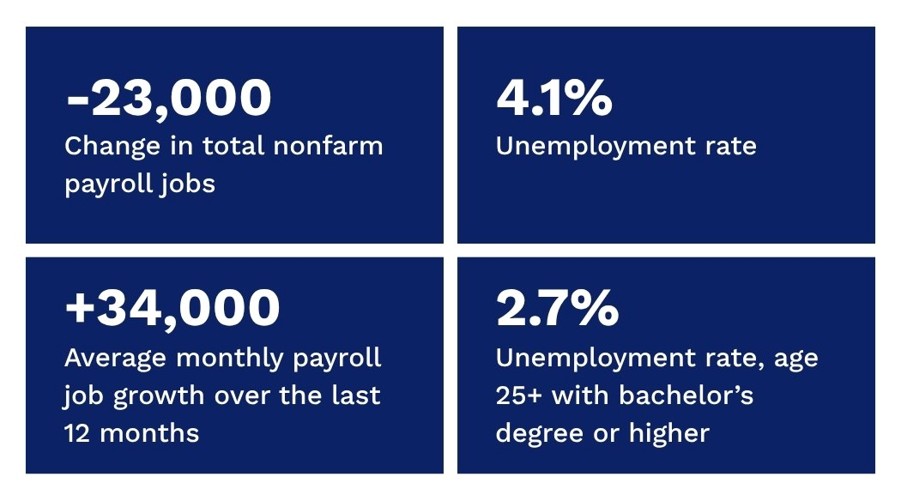
Total nonfarm payroll employment declined by 23,000 jobs in July, while the unemployment rate stood at 4.1%, down from 4.2% in June and 4.3% a year earlier. That combination is important: hiring has slowed considerably, but unemployment has remained relatively low, meaning employers should not assume the slowdown has created a large new pool of available talent.
The bigger shift is in hiring momentum. Employers added an average of just 34,000 payroll jobs per month over the prior 12 months. More recently, the three-month average fell to only 20,000 in July, compared with 142,000 in May. In other words, employers are adding far fewer jobs, but the available labor pool has not expanded to the degree that the slowdown in hiring alone might suggest.
For staffing leaders, HR executives, and business decision-makers, however, the headline numbers should not be interpreted as evidence that talent shortages have disappeared.
A softer labor market can give employers more room to be deliberate. It does not guarantee that the candidates they need, in the locations they need them and with the right combination of technical expertise, industry knowledge, and experience, are suddenly plentiful.
Hiring Growth Has Slowed Across the U.S. Labor Market
July’s 23,000 decline in payroll employment needs to be viewed alongside significant revisions to earlier estimates.
103,000 fewer jobs across May and June than previously reported
| Initially reported | Revised | |
| May | +129,000 | +63,000 |
| June | +57,000 | +20,000 |
May employment growth was revised from 129,000 to 63,000, while June was revised from 57,000 to just 20,000. Combined, the two months contained 103,000 fewer jobs than previously reported.
Those revisions matter because they change the picture from one weak month to a broader period of restrained hiring.
At the same time, the July headline was heavily influenced by government employment, which fell by 53,000. Local government education alone declined by 50,000. Private-sector employment still increased by 30,000.
That distinction is important for workforce planning. The labor market outlook is softer, but employers should be cautious about translating one national payroll number directly into assumptions about their own access to talent.
A “Hire Slow, Fire Slow” Labor Market Is Taking Shape
The current environment can increasingly be characterized as “hire slow, fire slow.”
Companies may approve fewer positions, scrutinize vacancies more closely, or take longer to authorize permanent additions. At the same time, the BLS data does not indicate a broad surge in permanent job losses. The number of permanent job losers changed little at 1.7 million in July, although the number of people on temporary layoff increased.
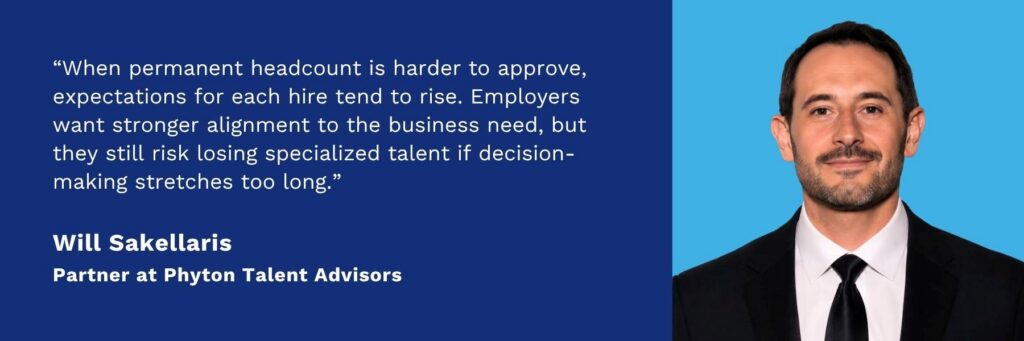
For talent acquisition teams, this means fewer approved vacancies can carry greater weight. When permanent headcount is harder to secure, employers may expect closer alignment between a candidate’s capabilities, experience, and the specific business need behind the role. That can make hiring more selective and extend decision cycles without necessarily creating a much deeper pool of qualified candidates.
That distinction matters. Employers can take a more deliberate approach to deciding which roles to open, but once the right candidate is identified, specialized talent may still have alternatives. A slower hiring market does not necessarily give companies unlimited time to make a decision.
A Softer Labor Market Has Not Eliminated Competition for Skilled Talent
Perhaps the most important number for employers recruiting professional and specialized talent is not the 4.1% headline unemployment rate.
Among workers aged 25 and older with a bachelor’s degree or higher, unemployment remained just 2.7% in July.
That does not prove that every highly skilled occupation is tight. But it illustrates why broad unemployment statistics can be misleading when applied to specialized hiring.
The relevant labor market for a senior accountant, compliance specialist, investment professional, technology leader, or experienced operations executive is rarely “the U.S. workforce.” It may be a much narrower population defined by occupation, industry experience, geography, seniority, certifications, technology expertise, or some combination of those factors.
An employer may receive more applications today than it did two years ago and still struggle to find five candidates who meet the requirements that actually matter.
This is where talent acquisition strategy needs to become more precise. Instead of asking whether the labor market is loose or tight, employers should ask: How available is this particular skill set in this particular market?
Temporary Help Employment Points to a Potential Shift Toward Workforce Flexibility
Temporary help services added roughly 3,400 jobs in July, a small number on its own, but the trend behind it is more telling than the single month. Temp help employment rose in May, gained further in June, and grew again in July, three consecutive months of increases after this same category was shrinking a year earlier, when it lost over 10,000 jobs in July 2025.
For employers, contract, interim, and project-based talent can provide a way to address immediate business needs while preserving workforce flexibility. As permanent hiring becomes more selective, contingent talent may become an increasingly important part of how organizations access capabilities that cannot wait for headcount conditions to change.
Slower Hiring Does Not Remove the Need for Talent Market Precision
The July Employment Situation report points to weaker hiring momentum. Employers have reason to be more deliberate about where they add headcount and how they structure their workforce.
But a hire slow, fire slow labor market creates its own challenges. Companies may have fewer vacancies, yet the roles they do approve are often important enough to warrant careful hiring. That increases the value of understanding where qualified candidates exist rather than assuming that a softer economy has solved talent scarcity.
For staffing and talent acquisition leaders, the opportunity is to use the current market to make more informed decisions: define requirements carefully, distinguish between essential and trainable skills, understand where specialized talent remains scarce, and choose the right balance of permanent and flexible talent for the work that needs to get done.
Staffing partners can play an important role by translating national and industry-level labor-market signals into the much narrower talent markets that determine whether a particular search will actually be easy or difficult.

