

The August Jobs Report Points to a Healthier but Still Selective Labor Market

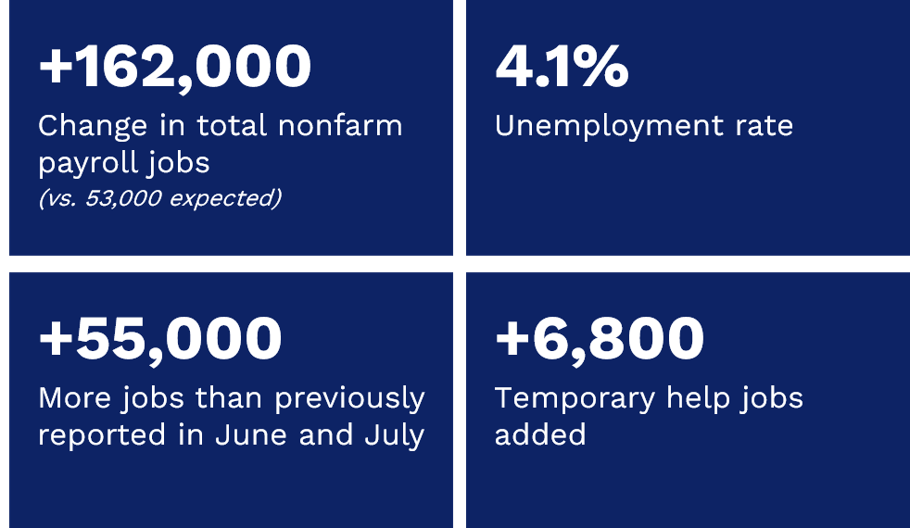
For much of the summer, hiring managers had good reason to feel uneasy. June and July payroll numbers looked weak, unemployment was ticking upward, and the labor market seemed to be losing momentum. Then August delivered 162,000 new jobs, more than three times the average monthly gain of the past year. The unemployment rate held steady at 4.1 percent. On the surface, it looks like a turnaround.
The August 2026 Labor Market at a Glance
But one strong month does not undo a pattern, and it does not mean employers should expect a wave of aggressive hiring. The more accurate read is that the labor market is healthier than the early summer suggested, while still functioning in a selective, cautious mode that has direct implications for how financial services and professional services organizations approach talent.
August Delivered a Much Stronger Jobs Report
Total nonfarm payroll employment rose by 162,000 in August, according to the Bureau of Labor Statistics, well above the 31,000 average monthly gain recorded over the prior twelve months.
Heading into the release, forecasts reflected the softer trend from earlier in the summer: the Wall Street Journal reported economists it surveyed had expected 53,000 jobs, while economists polled by Reuters had forecast 56,000. The actual print came in roughly three times higher than either estimate, making it a clear upside surprise across the board.
Why the Upward Revisions Matter
Just as important, the BLS revised its prior two months upward. June’s initial estimate of 20,000 jobs was revised to 31,000, and July’s original figure of negative 23,000 became a positive 21,000. Combined, June and July employment came in 55,000 higher than first reported.
| Initially reported | Revised | |
| June | +20,000 | +31,000 |
| July | -23,000 | +21,000 |
Those revisions matter beyond the arithmetic. They suggest the labor market was never as weak as the early estimates implied, and they take some pressure off the narrative that hiring was collapsing heading into the back half of the year.
One Strong Month Does Not Mean Hiring Has Fully Reaccelerated
It is tempting to treat August as confirmation that hiring is back. The details argue for restraint. A meaningful share of the gain came from food services and drinking places, which added 59,000 jobs, and local government education, which added 42,000 largely as a rebound from a prior-month decline. Both are categories prone to swings that do not necessarily reflect broader hiring appetite.
The “Low Hire, Low Fire” Environment
The Wall Street Journal has described the current environment as “low hire, low fire,” a phrase worth sitting with. Layoffs remain limited, employers are holding on to the staff they already have, but the pace of new hiring has also been depressed for some time. The Journal notes the U.S. has averaged roughly 80,000 jobs a month so far in 2026, itself a step up from an average closer to 10,000 a month in 2025, yet still a far cry from a broad hiring boom.
For hiring leaders, the takeaway is straightforward. Treat August as a genuine positive data point, not a signal to abandon hiring discipline.
Why the Labor Market Can Feel Tough Even With 4.1% Unemployment
A 4.1 percent unemployment rate sounds like a labor market that favors job seekers. For many candidates, it does not feel that way, and a Gallup survey cited by the Journal found only 34 percent of respondents believed it was currently a good time to find a quality job.
What Low Hire, Low Fire Means for Movement
The explanation lies in the low hire, low fire dynamic. When companies are not laying people off but also are not opening many new roles, voluntary movement slows. Qualified professionals who might otherwise explore a new opportunity choose to stay put, since fewer comparable openings exist and job security carries more weight than usual.
Volume Without Quality
At the same time, the roles that do open often draw a large pool of applicants. Fewer openings combined with more caution among currently employed candidates can generate high applicant volume without necessarily generating high-quality applicant volume. Recruiting and hiring teams that rely on volume alone will likely find themselves sorting through a lot of noise to find the signal. Stronger screening and more rigorous assessment become the difference between filling a role and filling it well.
What the August Jobs Report Means for Financial Services Hiring
Financial activities declined by about 11,000 jobs in the August establishment survey, but one month should not be treated as evidence of broad financial-services contraction. BLS itself categorized the sector as showing little change over the month.
Targeted Demand in Specific Functions
For banks, asset managers, fintechs and other financial institutions, the more useful takeaway is that hiring may remain targeted rather than expansive. Even when overall headcount growth is muted, organizations can continue investing in roles tied to specific needs, including specialized technical, regulatory, risk, transformation, revenue-generating and difficult-to-fill positions.
That raises the bar for both sides of the hiring process. Employers need clarity on which capabilities are genuinely scarce or business-critical. Candidates need to demonstrate how their experience can translate into the outcomes attached to the role.
The Journal also flagged that information and finance are among the sectors generally viewed as more exposed to AI-driven change, though neither the BLS data nor other reporting establishes that AI caused August’s decline in those industries. It is a trend worth watching, not a conclusion to draw yet.
For talent leaders, the practical implication is that hiring approvals in financial services are likely to stay tied closely to specific business cases rather than general growth targets.
Flexibility Could Remain a Priority for Employers
Temporary help services added about 6,800 jobs in August, a modest but notable data point given the broader hiring caution. When companies see real demand but are not ready to commit to permanent headcount, contract and project-based talent offers a way to close the gap.
This kind of flexible staffing lets organizations address near-term capability gaps, staff up for a specific initiative, and evaluate how a role performs before converting it to a permanent position. It also preserves access to specialized skill sets in areas where full-time hiring approval may take longer to secure. None of this replaces permanent hiring where the business case is clear, but it gives employers a practical middle path while the broader picture continues to firm up.
What Employers Should Watch Next
Sustained growth matters more than one headline
The next few reports will show whether August was the beginning of a more durable improvement or a strong month within a still-selective market.
Employers should watch whether payroll growth remains elevated and whether the August figure holds through revisions. The breadth of hiring will matter as much as the headline total, particularly in financial activities, professional and business services, information and temporary staffing.
Wage growth and labor supply will add context
Average hourly earnings rose 3.1 percent year over year in August, below the 3.4 percent inflation rate reported for July. If that relationship persists, real wage growth could remain constrained, with implications for compensation pressure, retention, and consumer demand.
Labor force participation also edged up from 61.4 percent to 61.6 percent, but remains 0.5 percentage point below January. That suggests some improvement in labor supply without a full return to earlier-year levels. Temporary staffing trends will also be worth watching for signs that employers are adding capacity while remaining cautious about permanent headcount.
Conclusion
August gives employers considerably more reason for confidence than June and July did. The upward revisions alone reduce the risk that the labor market was deteriorating faster than reported, and the headline number beat expectations by a wide margin. None of that removes the need for hiring discipline. The environment still rewards employers who can distinguish between roles that require permanent headcount, work that calls for short-term capability, and needs best met through flexible talent.
Organizations that build that kind of clarity into their hiring approach now will be better positioned to move quickly if hiring demand continues to strengthen through the fall.

