

Where Skill Demand Is Accelerating in Financial Services

What capabilities are defining high-performing financial services teams today–and shaping the years ahead? To answer that question, Phyton Talent Advisors analyzed recent financial services job posting data using Lightcast labor market intelligence, examining skill growth trends, wage momentum, and hiring demand across the industry.
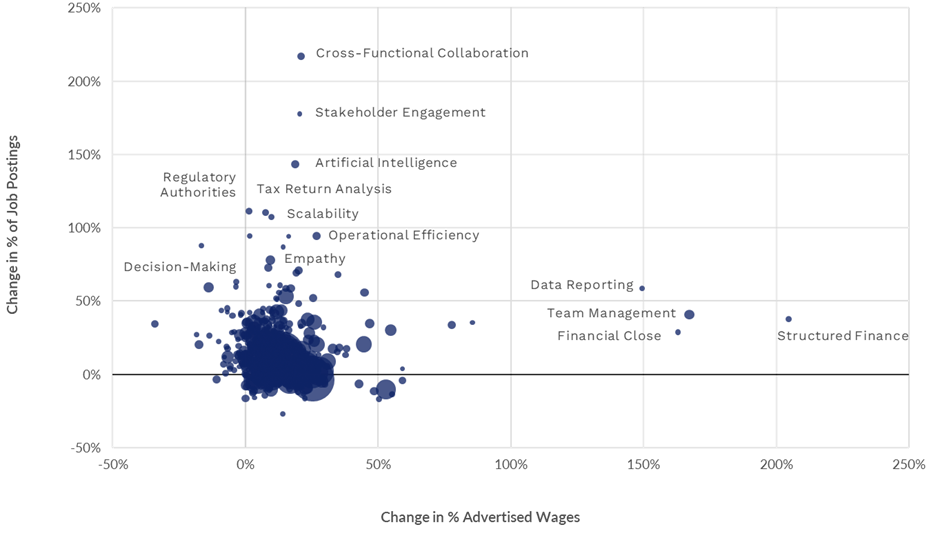
The findings show steady overall hiring activity, but a clear recalibration in the skills employers are prioritizing. Growth is strongest at the intersection of regulatory judgment, cross-functional execution, digital fluency applied within controlled environments, and leadership capability that connects risk, technology, and business performance. Financial organizations are not just hiring more. They are redefining what capability looks like.
Below, we break down the individual skill signals and broader capability categories shaping financial services hiring.
Individual Skill Signals: What’s Rising Fastest
Cross-Functional Collaboration Is Now a Core Requirement
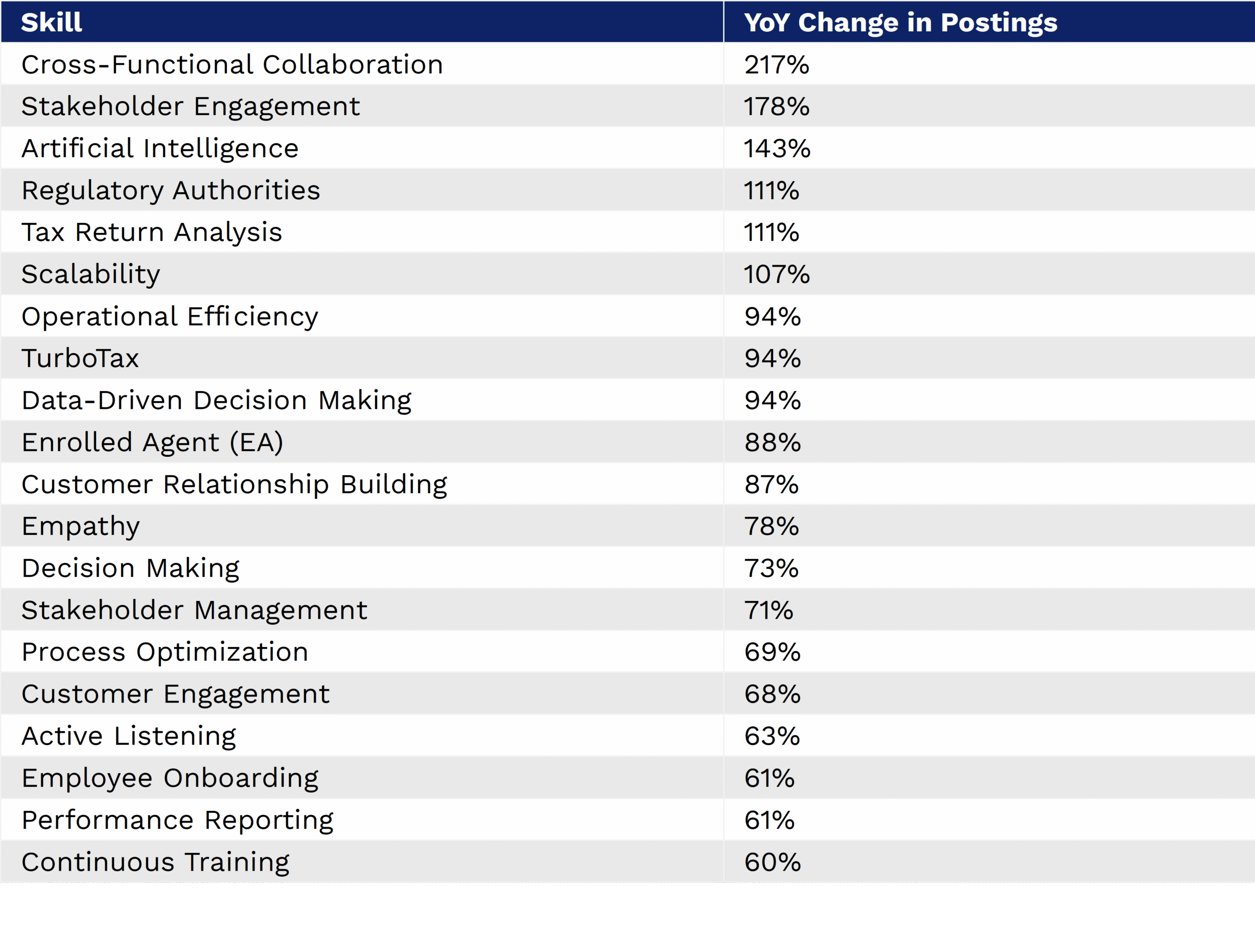
The fastest-growing skill in financial services job postings is cross-functional collaboration, with growth exceeding 200% year over year.
Closely related capabilities are also rising sharply: stakeholder engagement, decision-making, and operational efficiency. Together, these skills point to a clear priority: financial organizations are hiring professionals who can connect moving parts, align stakeholders, and drive outcomes in complex environments.
Collaboration is no longer a “nice to have.” It is embedded into expectations for leadership and execution.
AI and Digital Skills
Artificial intelligence shows substantial posting growth, exceeding 140% year over year. However, the context is important. AI demand is appearing alongside skills such as regulatory authorities, tax return analysis, and enrolled agent credentials. That pairing tells a clear story: financial organizations are not pursuing AI in isolation. They are integrating it into regulated, high-accountability environments.
Data reporting is also showing above-average wage growth, reinforcing that technological fluency now carries a compensation premium when paired with domain expertise.
Operational Efficiency and Scalability
Process optimization and performance reporting skills are also appearing more frequently in hiring requirements. As transaction volumes grow and audit scrutiny intensifies, institutions are seeking professionals who can:
- Streamline workflows
- Implement reporting discipline
- Improve scalability without weakening controls
Efficiency in financial services is not simply about speed. It is about disciplined scalability within established frameworks.
Skill Categories Driving Market Momentum
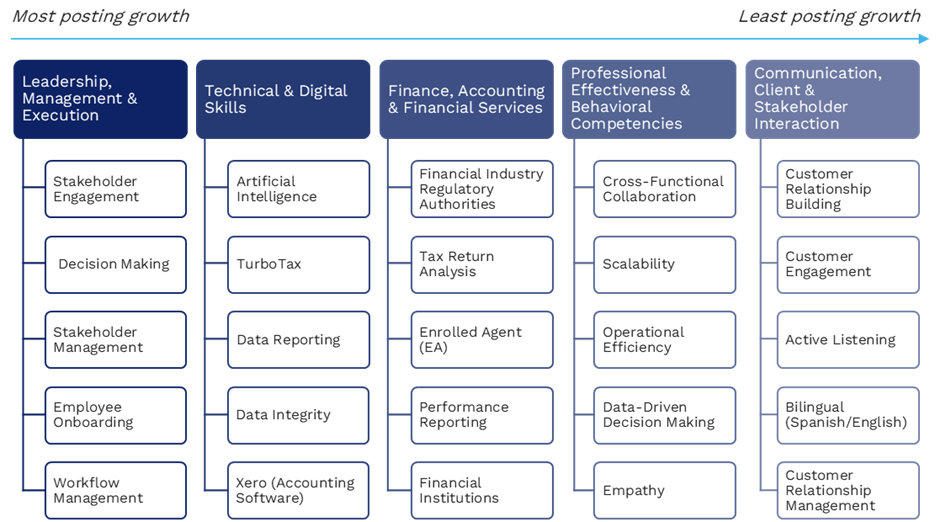
Leadership and Execution Skills Are Driving Both Demand and Pay
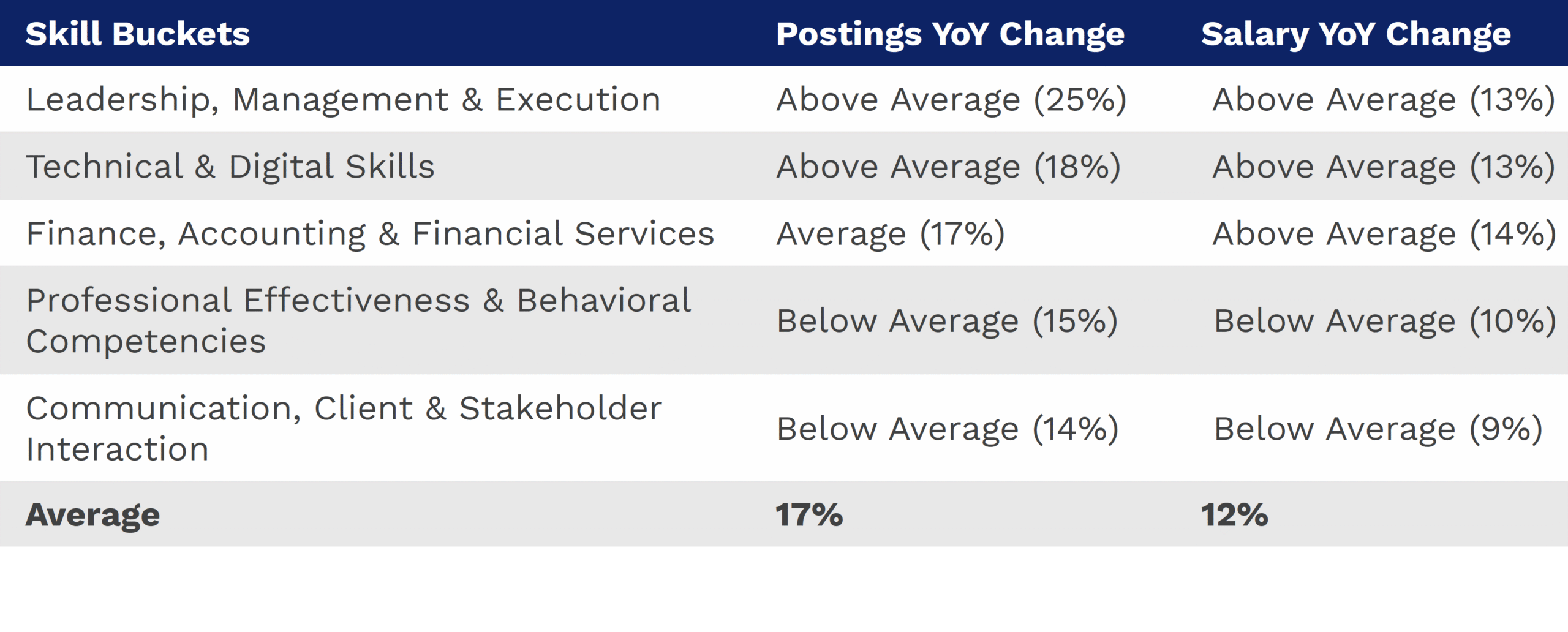
When skills are grouped into broader categories, leadership, management, and execution capabilities show the strongest hiring and wage momentum.
This reflects the operating environment financial institutions face. AI adoption, regulatory evolution, cost pressure, and operational modernization are happening simultaneously. That requires leaders who can coordinate across functions and deliver results without compromising controls.
Leadership in 2026 is less about hierarchy and more about capability. Organizations are prioritizing professionals who can:
- Align stakeholders across departments
- Make informed decisions under ambiguity
- Escalate appropriately within defined processes
- Maintain accountability across teams
These expectations extend beyond senior executives. Mid-level managers and project leaders are increasingly expected to operate with enterprise-level awareness.
Digital and Data Fluency in Financial Contexts
Digital skills are rising across finance, accounting, compliance, and risk functions.
However, their value is amplified when paired with domain knowledge. A financial analyst with advanced data visualization capability carries more weight than one relying solely on manual models. A compliance professional who understands reporting systems and automation brings broader impact.
Hybrid digital-finance capability is commanding stronger demand and compensation
Core Finance and Regulatory Expertise
Traditional accounting, financial reporting, and regulatory knowledge remain foundational. What is changing is how these skills are weighted. Core expertise alone is no longer sufficient. The market is rewarding professionals who combine subject-matter depth with cross-functional awareness and digital literacy.
Specialization remains critical. But it increasingly functions as the base layer of a broader capability stack.
Behavioral and Communication Skills Are Now Baseline Expectations
Communication and professional effectiveness skills may not show dramatic wage acceleration, but they have become embedded expectations.
Active listening, stakeholder management, empathy, and communication discipline are assumed components of professional competence. Organizations are no longer willing to treat them as optional enhancements.
In high-accountability environments, communication failures create measurable risk. As a result, firms expect professionals to demonstrate clarity, precision, and accountability as standard practice.
The Skills Investment Question: Where to Prioritize
The challenge is not simply identifying which skills are growing. It is deciding where to invest.
Some skills carry both high strategic value and high market scarcity. These roles, such as AI-finance hybrid experts or specialized regulatory leaders, require deliberate retention strategies and focused recruiting partnerships.
Other skills show strong demand but are more scalable through internal development. Cross-functional project leadership and advanced reporting capabilities often fall into this category.
Still others may be candidates for automation or process redesign, particularly routine reporting or transactional functions.
The most effective organizations are taking a portfolio approach to talent investment, aligning hiring and development priorities with both market scarcity and business impact.
Implications for Financial Organizations
The skills data signals three clear implications:
1. Hybrid Capability Will Define Competitive Advantage
The strongest growth sits at the intersection of finance expertise, digital fluency, and cross-functional leadership.
Organizations that design roles around blended capability will be better positioned to navigate regulatory complexity and digital transformation simultaneously.
2. Skills-Based Hiring Will Outperform Credential-Driven Selection
Employer pedigree and tenure still matter, but they are no longer decisive on their own.
Hiring teams must assess decision quality, stakeholder alignment, and the ability to operate within defined controls. Structured interviews, scenario-based evaluation, and consistent criteria are becoming essential tools.
3. Workforce Strategy Must Align with Business Strategy
Talent decisions can no longer be siloed in HR.
Workforce planning must integrate with digital roadmaps, regulatory planning, operational scaling, and risk management. Firms that treat workforce transformation as a business capability, rather than a reactive function, will maintain stronger control environments and execution quality.
A New Standard for Financial Services Hiring
The financial services labor market is not simply expanding. It is recalibrating.
Decision quality, cross-functional impact, digital application, and regulatory fluency are redefining how value is measured. Leadership and execution skills are driving growth, AI is being embedded within governance structures, and core finance expertise is being enhanced, not replaced.
The organizations that perform consistently will be those that align hiring decisions with these realities.
Partnering with a recruiting firm that understands hybrid, high-accountability roles can help financial institutions identify professionals who are prepared to operate at this intersection.
Connect with Phyton Talent Advisors to discuss how we help financial organizations hire for the blended capabilities shaping 2026 and beyond.

