

The Human Skills That Predict Success in High-Accountability Financial Services Roles

What Phyton’s analysis of global hiring demand reveals about the capabilities that actually separate strong performers from average ones.
In financial services, a single judgment call can move millions of dollars, trigger a regulatory inquiry, or cost a client relationship built over a decade. Compliance officers, risk managers, audit leads, traders, and the technologists who support them all operate in roles where the cost of failure is asymmetric. A strong performer compounds value quietly over years. A weak hire surfaces problems all at once, often after the damage is done.
Hiring managers know this, which is why financial services recruiting has long emphasized credentials, certifications, and pedigree. Those signals still matter, but they have become table stakes, and they consistently fail to predict who will actually thrive once the pressure is real. Phyton’s recent analysis of global job postings makes this shift visible in the data itself. The capabilities employers are now willing to pay for, and competing hardest to find, are overwhelmingly human skills. For high-accountability roles in financial services specifically, the implications are sharper than in any other sector.
What the Data Shows About Human Skills in Financial Services
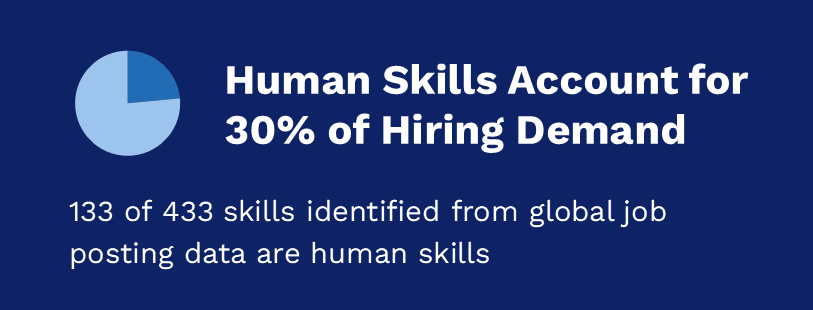
Our Talent Intelligence team analyzed 433 distinct skills extracted from global job postings over the past twelve months. Of those, 133 were classified as human skills, meaning capabilities that depend on judgment, behavior, or interpersonal capacity rather than tools or technical execution. Together, those human skills now account for roughly 30% of total hiring demand worldwide.
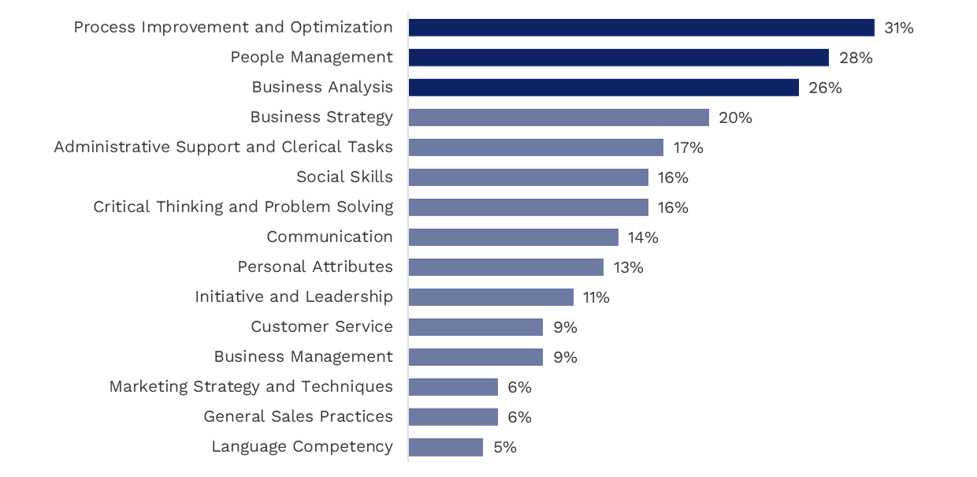
More telling is which human skills are growing fastest. The top three by year-over-year posting growth are Process Improvement and Optimization at 31%, People Management at 28%, and Business Analysis at 26%. Business Strategy follows at 20%, with Critical Thinking and Problem Solving at 16% and Communication at 14%. Each of these maps directly onto the daily reality of accountable roles in banks, asset managers, and insurers. The pattern is clear: employers are no longer paying a premium for people who can simply execute the work. They are paying for people who can improve the work, own the work, and defend the work under pressure.
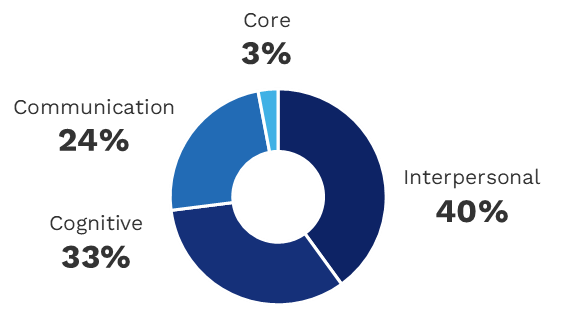
The data also reorganizes itself usefully. When Phyton grouped the 133 human skills into functional categories, Interpersonal skills accounted for 40% of the set, Cognitive skills 33%, Communication 24%, and Core traits like adaptability and accountability 3%.
Five Human Skills That Predict Success in High-Accountability Roles
Drawing from the data and from what Phyton’s clients consistently identify as their strongest hires, five capabilities show up repeatedly. None of them appear on a resume. All of them can be assessed, if you know what to look for.
1. Sound Judgment Under Ambiguity
High-accountability roles rarely come with clean inputs. A compliance officer reviewing a flagged transaction or an operations lead resolving a settlement break is working with incomplete information and time pressure. The 16% growth in demand for Critical Thinking and Problem Solving reflects how much employers now value the ability to make defensible decisions when the right answer is not obvious. Just as importantly, strong performers know which decisions to escalate. This capability is the single one AI is least able to replicate.
2. Ownership and Follow-Through
People Management demand grew 28% year over year, and the signal is broader than the label suggests. Employers are pushing management capability deeper into the organization, expecting ownership behavior from individual contributors well before they carry formal titles. In financial services, this matters acutely. Accountability is not a value statement on a wall, it is the operating reality. The strongest performers treat every issue they touch as theirs until it is closed. In interviews, this surfaces in how candidates talk about past mistakes. Specificity about what they did wrong and what they changed afterward is the signal you want.
3. Communication That Holds Up Under Scrutiny
Communication grew 14%, and in financial services the threshold is higher than in most sectors. A risk manager who cannot explain a model to a regulator, a banker who cannot translate complexity for a client, or an internal auditor who cannot deliver hard findings without provoking defensiveness will struggle regardless of technical depth. The candidates who thrive can compress a complicated situation into a clear narrative, hold their position when challenged, and adjust their explanation for the audience without losing precision.
4. Process Improvement Instinct
The fastest-growing human skill is Process Improvement and Optimization at 31%. That is not an accident. Across every accountable function in financial services, the work is being reshaped by automation, regulation, and scrutiny. Candidates who instinctively look for the failure points in a process, propose practical fixes, and implement them without disrupting controls are far more valuable than those who simply execute the process as given. This is also the skill that ages best, because the processes themselves keep changing.
5. Business Judgment Paired with Discipline
Business Analysis grew 26% and Business Strategy 20%. What both signals point to is the same underlying capability: the ability to connect a specific decision to a broader commercial context, then act on it within the procedural constraints these roles demand. Adaptability without rigor is a liability in financial services. Rigor without adaptability becomes obsolete. Candidates who hold both are the profile that compounds over a career.
How to Assess Human Skills in Financial Services Hiring
The challenge with human skills is that they are easy to claim and hard to verify. Most hiring teams already sense this, which is why the same questions surface in nearly every search:
- What does our interview reveal about a candidate that their resume does not?
- If a candidate is highly polished, can we tell whether the polish is hiding a gap?
- Do we know how this person handles a hard moment, or only how they handle interviews?
A few practical shifts make the assessment far more reliable:
Replace Generic Behavioral Questions with Role-Specific Scenarios
Asking a candidate how they handle pressure invites a rehearsed answer. Walking them through a real situation your team faced last quarter, and asking what they would do, invites reasoning. The point is not to test whether they reach the same conclusion you did. It is to hear how they think when the inputs are incomplete and the stakes are real. For high-accountability roles, that reasoning is the job.
Listen for How Candidates Reason, Not Just What They Conclude
Strong candidates in accountable functions tend to surface the tradeoffs before they land on an answer. They name what they would want to verify, who they would consult, and what would make them change their position. Weaker candidates jump straight to a confident conclusion. In interview debriefs, push every interviewer to capture not just the answer the candidate gave, but the path they took to get there.
Use a Structured Scorecard Across Every Interviewer
When each interviewer evaluates against their own criteria, hiring decisions drift toward whoever was most personable in the room. A structured scorecard, with the five capabilities above defined in plain language and rated against specific evidence from the conversation, forces the panel to compare candidates on the same dimensions. It also surfaces disagreement early, which is usually where the most useful conversation about a candidate happens.
Require Evidence Before Advancing a Candidate
Impressions are not evidence. Before moving a candidate forward, the interviewer should be able to point to something specific the candidate said or described that demonstrates the capability in question. If no one can cite that evidence, the rating is a guess. This is the discipline that prevents promising-on-paper candidates from advancing on charisma alone.
Weight References Who Have Seen the Candidate Make a Hard Call
A reference who confirms the candidate delivered a project on time tells you very little about how they will perform when accountability is on the line. A reference who has seen them push back on a senior stakeholder, escalate a sensitive issue, or own a mistake publicly tells you almost everything you need to know. When you ask for references, ask specifically for someone who has been in the room when it counted.
Together, these shifts compress a long, expensive search into a short shortlist of people who will actually perform. They are also the work most hiring processes skip, which is why so many financial services hires look strong on day thirty and disappointing on day three hundred.
Conclusion: Why Human Skills Now Define Financial Services Performance
Technical skills will get a candidate considered. Credentials will get them interviewed. Human skills, the five above in particular, are what determine whether they hold up once the accountability is real. The hiring data already reflects this shift: when 30% of global hiring demand sits in human skills and the fastest-growing capabilities are about improving, owning, and defending the work, the firms that win the talent competition will be the ones who learn to assess for these capabilities deliberately.
If your team is filling a high-accountability role and the last few hires have not held up the way you expected, the gap is almost certainly here. Phyton’s qualification process is built around these dimensions specifically, which is why our shortlists run at a 2:1 interview-to-hire ratio rather than the industry norm. We would welcome a conversation about the role you are trying to fill.

