

Front Office Hiring Trends 2026: Why Postings Jumped 118%

Front office investment banking hiring has moved faster in the past twelve months than at any point in the last three years. The data behind that shift, drawn from Phyton’s analysis of Lightcast job posting and compensation data, points to a clear story about where the market is heading and what it requires from hiring managers competing for front office talent.
This article examines what is driving front office hiring trends in 2026, what the wage data reveals about how banks are deploying compensation, who firms are competing against for the strongest candidates, and what the figures indicate about how front office hiring should be approached for the remainder of the year
Global Front Office Hiring Trends Signal Renewed Competition
After declining steadily through late 2023 and much of 2024, global job postings for front office roles began recovering in early 2025 before accelerating sharply into 2026. Despite the earlier slowdown, posting volumes in April of this year were still 78% higher than May 2023 levels, including 118% growth over the past year alone.
Global Job Postings for Front Office Talent
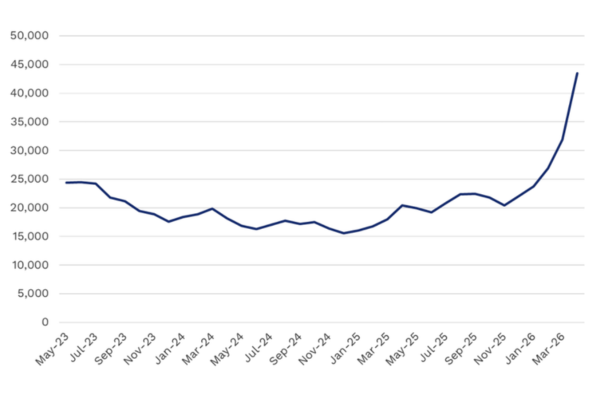
(May 2023 – April 2026)
For HR and Talent Acquisition leaders, this pattern suggests that organizations may have moved from a cautious hiring environment into a renewed competition for revenue-generating talent. Front office functions are often among the first areas to rebound when firms regain confidence in market activity, client demand, or growth opportunities. The speed of the increase also indicates that many organizations may now be hiring simultaneously, creating tighter competition for experienced professionals.
This creates pressure not only on sourcing strategies, but also on hiring speed, recruiter specialization, and employer positioning within highly competitive financial services markets.
What Front Office Wage Trends Reveal
Advertised wages for front office talent followed a different trajectory than job posting volume. Compensation declined significantly through late 2023 before rebounding strongly across 2024, eventually peaking above $120,000 in early 2025. Since then, wages have fluctuated rather than continuing upward, settling closer to the $100,000 range despite the recent surge in hiring demand.
Global Advertised Wages for Front Office Talent
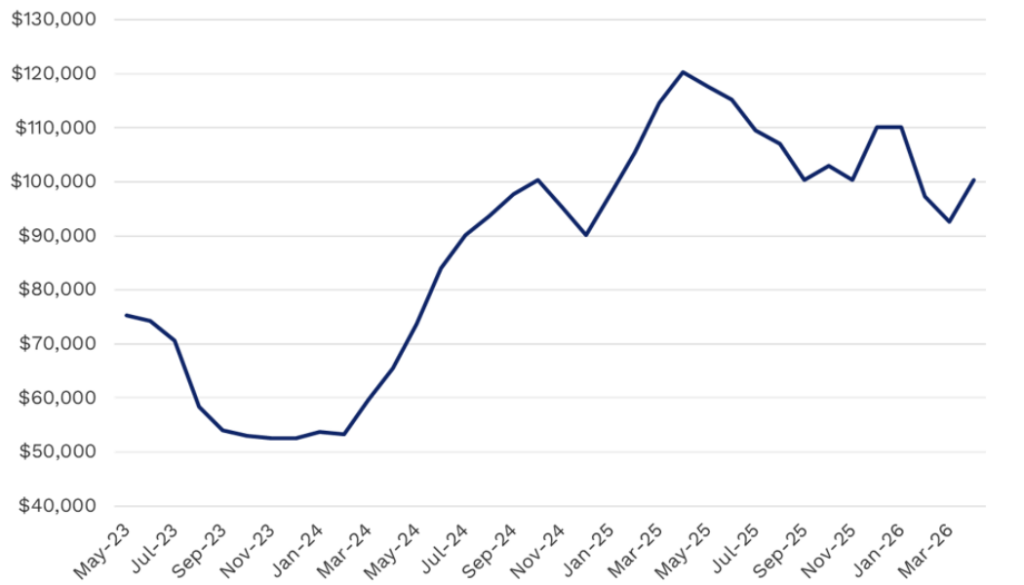
(May 2023 – April 2026)
For Talent Acquisition leaders, this divergence is important. Hiring demand appears to be rising faster than compensation pressure, suggesting that employers may still have access to broader talent pools than in previous market cycles. It may also indicate that organizations are prioritizing selective hiring over aggressive bidding wars, particularly as firms balance growth expectations with cost discipline.
At the same time, wage volatility remains elevated compared to earlier periods. This signals continued competition for highly specialized or revenue-driving talent, even if broad market compensation has not yet accelerated at the same pace as hiring demand.
Who Firms Are Competing Against for Front Office Talent
The Top Companies Competing for Front Office Talent
| Company | # of Unique Postings |
| JPMorgan | 9,190 |
| Citigroup | 4,360 |
| Goldman Sachs | 2,565 |
| Deutsche Bank | 2,456 |
| Morgan Stanley | 2,136 |
| HSBC | 2,124 |
| Wells Fargo | 2,101 |
| Royal Bank of Canada | 1,947 |
| Scotiabank & Trust | 1,911 |
| BNP Paribas | 1,904 |
The competitive set for front office talent is concentrated. Over the past three years, ten firms accounted for the largest share of front office postings, led by JPMorgan, Citigroup, Goldman Sachs, Deutsche Bank, Morgan Stanley, HSBC, Wells Fargo, Royal Bank of Canada, Scotiabank, and BNP Paribas.
Firms hiring against this set are competing with employers that have developed brand recognition, compensation structures, and candidate experience over decades. That does not mean smaller or mid-tier firms cannot win the talent. It means the win has to come from somewhere other than brand recognition.
In our experience placing front office talent across these competitive sets, the firms that consistently land strong candidates against bulge bracket competition do three things well. They move quickly between first conversation and offer. They give candidates a clear and credible view of the work, the team, and the trajectory, rather than relying on generic pitch materials. And they qualify candidates rigorously upfront, so the people brought through the process are people the hiring manager would seriously consider, rather than a long list of resumes that consumes time without producing outcomes.
That final point is where most internal processes lose ground. A high interview-to-hire conversion rate is achievable, but only when the qualification work happens before the interview, not during it.
Three Takeaways for Front Office Hiring
First, hiring speed becomes increasingly important. In highly competitive front office markets, long hiring cycles often result in lost candidates. As more organizations compete for the same talent pools, delays in interview scheduling, approvals, or compensation decisions can quickly impact offer acceptance rates.
Second, employer positioning becomes increasingly important as hiring activity expands. Compensation remains important, but firms are competing on more than salary alone. Candidates are increasingly evaluating platform stability, deal flow, leadership reputation, advancement opportunities, flexibility, and long-term career positioning.
Third, recruiter specialization becomes more valuable. Front office hiring typically requires deeper market understanding than more generalized recruitment functions. Recruiters need credibility within highly specialized verticals, awareness of compensation expectations, and the ability to assess technical capability alongside relationship management and commercial judgment.
A More Competitive Market Ahead
The growth figures attract attention, but the more useful question is what they change about hiring practice over the next six months. The market is moving faster, the candidate pool is being courted harder, and the firms securing the talent are the ones treating hiring with the same rigour as the deals they are hiring people to execute.
Phyton has spent fourteen years placing front office talent for financial institutions across twenty-four countries. For a discussion of what current market conditions mean for a specific role or hiring plan through the rest of 2026, we would welcome the conversation.

